The Ultimate Guide to Lift Shaft Lifting Compliance: Testing Beams, Eyes, and Anchors Under LOLER

Lift shaft lifting compliance matters because the risks are high. A lift shaft is a confined space where gravity is unforgiving. If a lifting beam buckles or an eyebolt snaps, the consequences hit fast, equipment damage, project delays, and serious safety risks for engineers working in the shaft.
The frustration is common: the lift is ready, but the lifting points aren’t certified. Work stops. Teams wait. Schedules slip. Site costs rise by the hour. You know the delay isn’t caused by your team, it’s a missing certificate holding up the entire installation.
Industrial Lifting helps you avoid these stoppages. Our LEEA-certified engineers carry out load testing for lift shaft lifting points and beams with fast turnaround and a 24-hour response inside our service radius. We test lifting beams, lifting eyes, anchors, and support structures using calibrated equipment and clear, traceable reporting. The goal is simple: keep your installation moving and keep your engineers safe.
Industrial Lifting supports lift shaft projects with fast, compliant LOLER testing carried out by LEEA-certified engineers.
In this guide, you’ll learn exactly what LOLER requires, how lift shaft lifting points are tested, and what to expect during a proof load test.
The Regulatory Landscape: What You Actually Need to Know
Lift shaft lifting compliance sits under two main pieces of legislation: LOLER 1998 and PUWER 1998. In practice, LOLER is the one that governs how lifting beams, lifting eyes, anchors, and runway systems must be examined and certified before use.
Most delays on site come from misunderstanding what LOLER actually requires. This section removes the jargon so you know exactly what must be tested, who can test it, and when.
LOLER 1998 Explained (Only the Parts That Matter Here)
Regulation 9 – Thorough Examination
This is the rule that drives almost everything in lift shaft testing.
It states that lifting equipment must be examined:
- before first use
- after installation or reinstallation
- periodically (6 or 12 months depending on use)
- after exceptional circumstances such as damage, impact, or structural modification
For lift shafts, the relevant items include:
- lifting beams
- runway beams
- lifting eyes
- anchors (mechanical or chemical)
- any structural point intended to support a load
If it lifts or supports a load, it must be examined and certified.
For formal guidance on LOLER requirements, you can refer to the HSE’s official LOLER Approved Code of Practice (ACOP):
https://www.hse.gov.uk/work-equipment-machinery/loler.htm
Installation vs. Periodic Testing: The Difference That Causes Confusion
Installation / First-Use Testing
This takes place once the lifting point is installed.
You need this before anyone attaches a hoist or uses the shaft for lifting operations.
Purpose:
Confirm the lifting point is structurally sound, correctly positioned, and capable of handling its Safe Working Load (SWL).
Periodic Testing (6 or 12 Months)
Most lift shaft lifting points fall into a 6-month cycle, because they are often used for:
- man-riding
- repetitive servicing
- maintenance lifting inside the shaft
Anything connected to lifting people or lifting engineers defaults to a 6-month requirement.
A 12-month cycle applies only to lifting points used exclusively for goods which is rare in practice.
Most lift beams fall under a 6-month cycle. You can read more about how often LOLER testing should be done in our inspection frequency guide.
The Competent Person: Who Can Legally Sign Off a Lift Shaft Test
LOLER is clear: a Competent Person must have theoretical knowledge, practical experience, and impartiality.
It is not:
- the site manager
- the installer
- the lift engineer
- a general builder
A Competent Person must understand load paths, structural behaviour, testing techniques, and reporting requirements. This is why lift companies and contractors use independent specialist testers.
Industrial Lifting uses LEEA-certified engineers, which meets and exceeds the competence expectations set out in LOLER and industry best practice.
What This Means for Lift Shaft Projects
If you’re installing a new lift, modifying an existing shaft, or adding runway beams or lifting eyes, you legally need:
- a calculation report
- a proof load test
- a Report of Thorough Examination
- clear records showing SWL, date tested, and next due date
Missing any of these will halt the lift installation.
Lifting Beams: The Backbone of the Shaft
Lifting beams inside a lift shaft carry all the load from the hoist, whether you’re lifting engineers, equipment, or lift components. If the beam isn’t designed, installed, and tested correctly, the entire lifting operation is at risk. This section explains what needs to be in place before a beam can be used and why testing goes beyond simply “seeing if it holds the weight.”
All lifting beams must undergo a controlled proof load test before use.
The Calculation Report: The First Check Before Testing
Before any physical test, you need a Calculation Report.
This document confirms the beam has been designed to handle the intended load.
It covers:
- steel grade
- section size
- fixing method
- span
- expected load path
- predicted deflection
Without this information, a tester is working blind, and LOLER requires theoretical checks before practical ones. Testing a beam with no engineering data risks overload, structural damage, or collapse.
If you don’t have a Calculation Report, the test stops here.
The Proof Load Test: SWL + Overload
Once the calculations confirm the design, the beam is tested under controlled load.
Industry practice:
- Safe Working Load (SWL) + 25% overload
- Load is held for a set period
- All readings are recorded using calibrated equipment
This proves the beam can support the load safely in the real shaft environment, not just in theory.
For more detail on the difference between a proof load test and a standard load test, see our dedicated guide.
For lift shaft lifting compliance, this proof load test is a critical step. It confirms not only strength, but also the behaviour of the beam under load.
Deflection: The Invisible Risk
A beam can hold the required weight and still fail the test.
Why?
Excessive deflection.
If the beam bends too much:
- it may contact the lift car or shaft wall
- it may overstress supports
- it may not return to its original position after the load is removed
- it may signal fatigue or incorrect installation
During the test, two measurements matter:
- Deflection Under Load – does the beam bend within acceptable limits?
- Permanent Set – when the load is removed, does the beam return to line?
Any beam that stays bent fails immediately.
What This Means for Your Project
If your lifting beam doesn’t have:
- a Calculation Report
- a proof load test to SWL + overload
- deflection checks
- a valid Report of Thorough Examination
…it cannot be used legally under LOLER.
Most delays happen because one of these steps is missing.
“Recently used IL for beam removal and installation. They carried out a professional job and I was pleased with there works and service.” – Gary Paterson
Lifting Eyes and Anchors: The Hidden Dangers
Lifting eyes and anchors are some of the most common failure points in a lift shaft. They look simple, but the forces acting on them are anything but. Most issues come from incorrect installation, unsuitable substrates, or angular loading that reduces capacity without anyone realising.
This section explains the risks you need to know about and what LOLER testing checks for.
The Geometry of Failure: Why Angular Loading Breaks Eyebolts
Eyebolts are designed for vertical lifting.
As soon as you pull at an angle, the load rating drops fast, often by more than people expect.

What the diagram shows
- 0° vertical pull = 100% capacity (full Working Load Limit)
- 45° pull = capacity drops to around 30%
At 45°, the force splits into vertical and horizontal components.
The horizontal force tries to bend or shear the eyebolt, which it was never designed to handle.
What this means in a lift shaft
If someone rigs a chain block at an angle, even a slight one, the eyebolt may only be good for a fraction of its rated load. This is why the most common failures during testing are:
- eyebolts bending
- threads pulling out
- resin anchors debonding
- concrete cracking around the fixing
LOLER requires the Competent Person to assess not just strength, but also suitability for the direction of load.
Mechanical vs Resin Anchors in Concrete
Anchors inside lift shafts fall into two categories:
Mechanical Anchors
- wedge or expansion type
- rely on friction
- can crack weak or hollow substrates
- sensitive to installation torque
These often fail when installed into unknown or poor concrete.
Resin (Chemical) Anchors
- high bond strength
- better for cracked or variable concrete
- lower risk of installation error
- need correct cure time and mixing
Resin anchors are generally preferred for lift shafts because they handle dynamic and multi-directional forces better.
Pull-Out Testing: Proving the Anchor Is Safe
A visual check is not enough. Anchors must be tested using a hydraulic pull tester such as a Hydrajaws to confirm:
- actual load capacity
- correct bond with the concrete
- no movement under load
- no cracking in the substrate
If the anchor moves even a few millimetres, it fails.
This test is essential for lift shaft lifting compliance because the anchor is only as strong as the material holding it.
The Key Takeaway
Most lifting eye and anchor failures come from:
- angular loading
- unsuitable substrate
- incorrect installation
- poor-quality fixings
- lack of testing
LOLER testing picks up these issues before anyone starts lifting inside the shaft.
The Logistics of Testing: Safe and Precise Load Application
Testing lifting beams, lifting eyes, and anchors inside a lift shaft is rarely straightforward. Space is tight, access is limited, and getting heavy test weights into position isn’t always possible. That’s why the method used to apply the load matters just as much as the load itself.
Industrial Lifting uses a controlled system built around lever hoists, test plates, and calibrated load cells. This approach delivers accurate results and keeps the test safe, even in the most restricted shafts.
The Industrial Lifting Method: Lever Hoists + Load Cells
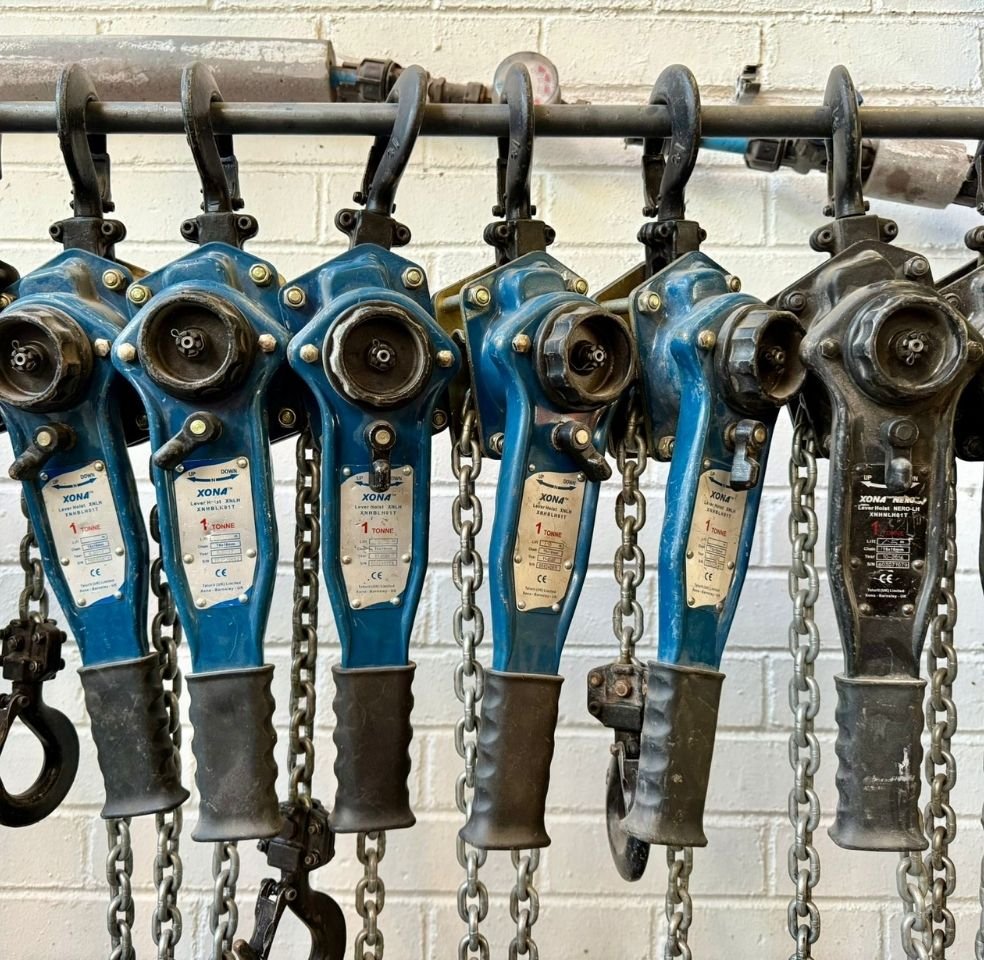
Instead of moving heavy iron weights through the building, we use:
- Lever Hoists (see image) – to apply force manually and gradually
- Test Plates / Reaction Plates – to create a secure test rig
- Calibrated Load Cells – to measure load in real time
This setup lets us test lifting points to their full proof load without bringing unnecessary mass into the shaft.
Why this matters
- No uncontrolled swings or shifting loads
- No manual handling risks from large test weights
- No requirement for wide clearances or floor space
- Load can be increased slowly and stopped instantly
- Exact load is displayed on the load cell at every stage
The result is precise testing with predictable outcomes.
Why This Method Is Ideal for Lift Shafts
Lift shafts are tight working environments. The hoist points are often above head height, surrounded by walls and structure. Lever hoists and load cells let us:
- apply load even when space is limited
- test directly in line with the lifting point
- avoid introducing extra weight that could damage the shaft
- complete testing faster, reducing site downtime
Because the system is compact and controlled, we can test in locations where test weights would be unsafe or impossible to use.
Real-Time Recording for Full LOLER Compliance
Load cells provide:
- exact applied load
- hold-time confirmation
- peak force
- deflection trends (when monitored alongside beam measurements)
This creates a clear audit trail for the Report of Thorough Examination, supporting compliance with LOLER Regulation 9.
What This Means for Your Project
Using lever hoists and calibrated load cells speeds up testing, improves accuracy, and reduces risk. It also means:
- faster certification
- less disruption on site
- no need for the client to supply test weights
- safer working conditions for engineers in the shaft
This method keeps your installation moving without compromising safety.
Our lever hoists and calibrated load cells are compact and ideal for shaft testing. If you need equipment for wider site work, our lifting equipment hire UK service covers nationwide supply.
The Testing Procedure: What to Expect on Site
Clients often ask what a LOLER test inside a lift shaft involves. The process is structured, controlled, and designed to pick up issues early. Knowing the steps helps you prepare the area, avoid delays, and keep the project moving.
Each test starts with a full visual inspection before any load is applied. If you need a simple overview of what a LOLER inspection involves, see our introductory guide.
Step 1: Visual Inspection
Every test starts with a close inspection of the lifting point.
We check for:
- cracks
- corrosion
- deformation
- damaged welds
- loose fixings
- poor installation
- signs of previous overloading
If anything looks unsafe, the test stops.
If the lifting point passes this stage, we allocate a serial number for traceability and continue.
Step 2: Setup
We install:
- the test rig
- the calibrated load cell
- lever hoists and reaction plates (or appropriate setup for anchors)
The goal is to create a stable, controlled way to apply load directly in line with the lifting point.
Step 3: Applying the Load
We apply load gradually using lever hoists.
Typical requirement:
Safe Working Load (SWL) + Overload
This overload proves the lifting point has margin beyond everyday use.
Load is held for a set period to check stability and behaviour under force.
Step 4: Measurement and Assessment
We take two key readings:
- Deflection Under Load
Does the beam or anchor move within accepted limits?
- Permanent Deformation After Unloading
Once the load is removed, does the lifting point return to position?
Any permanent bend or movement means a fail.
“I use Industrial Lifting Ltd for all our commercial lifting beam testing, always available when required to maintain programme. No hassle when onsite.” – Mark Millichap
Step 5: Certification
If the lifting point passes:
- we issue a Report of Thorough Examination
- we record the serial number, SWL, date tested, and next test date
- the lifting point is officially cleared for use under LOLER
This certificate is what allows the lift installation to continue without delay.
What This Means for Your Team
When the shaft is clear, access is safe, and the Calculation Report is available, the full testing process runs smoothly. Most delays happen when these items are missing. Preparing ahead reduces downtime and keeps your programme on track.
Common Reasons for Inspection Failure
Most delays in lift shaft lifting compliance come from issues that could have been spotted before the engineer arrived. Below are the problems we see most often and how they impact the test.
1. No Calculation Report
A lifting beam or runway beam cannot be tested without engineering data.
If we don’t know the intended load or design assumptions, the test stops immediately.
Impact:
Work stalls until calculations are produced and approved.
2. Unknown or Unsuitable Substrate
Anchors installed into:
- hollow blocks
- weak concrete
- old patch repairs
- unverified substrates
…often fail during pull-out testing.
If the substrate cannot support the load, the anchor is unsafe by default.
Impact:
Anchors must be removed and reinstalled correctly before testing can continue.
3. Incorrect Eyebolt Type or Angular Loading
Many eyebolts fail because they were fitted for vertical lifting only but used at an angle.
This reduces the Working Load Limit dramatically and is one of the most common causes of test failure.
Impact:
Eyebolts need to be replaced with rated types suitable for the loading direction.
4. Poor Installation
Common installation mistakes include:
- no torque control on mechanical anchors
- resin not mixed correctly
- resin not given enough cure time
- fixings installed too close to edges or weak areas
Impact:
The anchor either pulls out or shows movement during the test.
5. Damaged or Distorted Components
We often find:
- bent beams
- corroded plates
- cracked welds
- loose or missing fixings
Even minor damage can invalidate a lifting point.
Impact:
Repairs or replacements are required before any load is applied.
6. Lack of Access or Poor Housekeeping
If the shaft floor is covered in debris, or access to the lifting point is restricted, the test can’t start.
Impact:
Delays and additional site visits.
7. Missing Identification
Lifting points must have:
- a unique ID or serial number
- a recorded SWL
- clear documentation
Without this, certification cannot be issued.
Case Study: Runway Beam Installation and LOLER Testing in a High-Rise Lift Shaft

Lift shaft lifting compliance is often tested in demanding conditions. A recent high-rise project in Central London shows what this looks like in practice.
The site had three constraints:
- limited working space
- strict time windows
- work at height in a live urban environment
Industrial Lifting installed nine bespoke 3.5 m runway beams at 27 floors up. The team had a 14-hour operational window to complete:
- installation
- alignment
- proof load testing
- certification
Each beam was tested to its full proof load using calibrated load cells and controlled lifting methods. All beams stayed within deflection limits and returned to line after unloading.
Result:
- zero safety incidents
- zero delays
- site handed back on schedule
This project highlights the value of controlled testing, accurate load application, and clear communication with the lift installation team. Even in tight conditions and time-critical programmes, compliant lifting points can be installed and certified without disruption to the wider project.
“First time using Industrial Lifting Ltd who undertook the supply, install & testing of lifting eyes on a scheme in York. The process from onboarding to installation was exceptional with a proactive and positive approach. Upon review of our drawings and spec, they offered an alternative way of fixing the lifting eyes which was more cost effective.” – Tony Willison
FAQ’s Relating to Lift Shaft Lifting Compliance
These questions reflect what lift companies, site managers, and building contractors search for most often. Each answer is clear, direct, and written to support featured snippet visibility.
How often must lift beams be tested?
Most lift beams inside a lift shaft are used for man-riding or regular maintenance tasks. This puts them on a 6-month LOLER inspection cycle.
If the beam is used only for goods (rare in practice), the interval may move to 12 months.
If the beam is modified, moved, or damaged, LOLER requires an immediate re-examination.
Do I need to provide test weights for the proof load test?
No. Industrial Lifting uses lever hoists, test plates, and calibrated load cells.
This method applies the exact proof load without moving heavy weights through the building. It is safer, faster, and better suited to tight shafts.
What happens if my beam fails the test?
The lifting point must be taken out of service at once.
We record the defect and explain the cause.
Typical next steps:
- repair or replace the beam or anchor
- provide or request an updated Calculation Report
- schedule a retest once the issue is resolved
You cannot use the lifting point until it passes a new Thorough Examination.
What documents will I receive after a LOLER test?
You receive a Report of Thorough Examination that includes:
- serial number
- SWL
- date tested
- next test due date
- findings and measurements
- any defects or advisory notes
This report is your evidence of compliance under LOLER Regulation 9.
Can you test lifting points in a shaft with limited space?
Yes.
We use compact lifting equipment and load cells that work in tight conditions.
This avoids the manual handling risks and access challenges associated with traditional test weights.
What affects whether an eyebolt or anchor passes the test?
Key factors include:
- direction of load
- type of fixing
- substrate strength
- installation method
- correct curing of resin anchors
- resistance to pull-out
- movement under load
Angular loading is one of the most common causes of failure.
Do I need a Calculation Report before testing?
Yes.
A lifting beam cannot be tested until an engineering Calculation Report confirms the intended load, span, section size, fixings, and deflection limits.
Without this, any proof load test is invalid.
Lift shaft lifting compliance isn’t about paperwork. It’s about keeping people safe and keeping projects on schedule. A lifting beam, eyebolt, or anchor only becomes a compliant lifting point once it has been designed, tested, measured, and certified under LOLER.
When any part of that process is missing, work stops.
When it’s done correctly, your team can lift with confidence.
Industrial Lifting supports lift installation and construction teams with fast, reliable testing carried out by LEEA-certified engineers. We use controlled load application, calibrated equipment, and clear reporting to keep your programme moving.
If you have a lift shaft ready for testing — or a project coming up where lifting points need installing, aligning, or certifying — we can help.
Book your LOLER testing with a 24-hour response time and keep your installation on track.