
Introduction
A failed LOLER inspection can happen on any site. A worn chain link the operator never noticed. A safety catch missing from a hook. A certificate that ran out two weeks ago and nobody checked. Most failures come down to small things, but the consequence is the same. The equipment is out of service, the job stalls, and the duty holder has to act fast.
A failed LOLER inspection means the equipment is no longer safe to use. It must be taken out of service straight away. From that point, the duty holder is responsible for the next steps. Get the Report of Thorough Examination. Decide whether to repair or replace. Keep the job moving with a certified replacement. Update the records. In serious cases, the HSE may need to be notified.
This guide walks you through every step. What a failure actually means. What to do in the first hour, the first day, and the first week. How the Report of Thorough Examination works. When equipment can be repaired and when it must be replaced. And what your wider duties look like once the kit is back in service.
If a LOLER inspection is new territory, our what is a LOLER inspection guide covers the basics first.
What a Failed LOLER Inspection Actually Means
A LOLER inspection is not a simple pass or fail. The examiner is a competent person making a judgement about how serious any defect is. In practice, most examiners group their findings into three broad categories.
Immediate defects. The equipment is dangerous and cannot be used until the defect is fixed. Examples include a cracked load chain, a hook that has opened up, a brake that does not hold, or a structural defect in the body of the equipment. The kit comes out of service straight away.
Serious defects. The equipment cannot be used until the defect is remedied, but there is no immediate risk of failure. Examples include significant wear that is past the maker’s limit, a missing safety latch, or a paperwork failure such as a missing identification mark.
Other defects. The defect needs attention within a set timeframe, but the equipment can stay in service in the short term. Examples include light wear, minor corrosion, or a worn SWL marking that is still readable. The examiner sets the timeframe, and the work must be completed before the next examination.
Under LOLER, the examiner has a legal duty to notify the relevant enforcing authority of any defect that is or could become a danger to people. In practice, that usually covers the immediate category and sometimes the serious category, depending on the examiner’s judgement.
What happens next depends on how serious the defect is. An immediate or serious defect means the kit is grounded until it is sorted. An “other” defect means you have a window to plan the work without stopping the job. The Report of Thorough Examination will record each defect found, with the timeframe for fixing it.
First Steps When an Inspection Fails
The first hour after a failed LOLER inspection matters most. Get this part right and the rest is straightforward. Get it wrong and a paperwork problem becomes a safety problem.
There are six things to do straight away.
Take the equipment out of service. No exceptions. Even if the defect looks minor, the examiner has flagged it for a reason. Do not finish the lift, do not move one more load, do not “see how it goes.” Stop using it now.
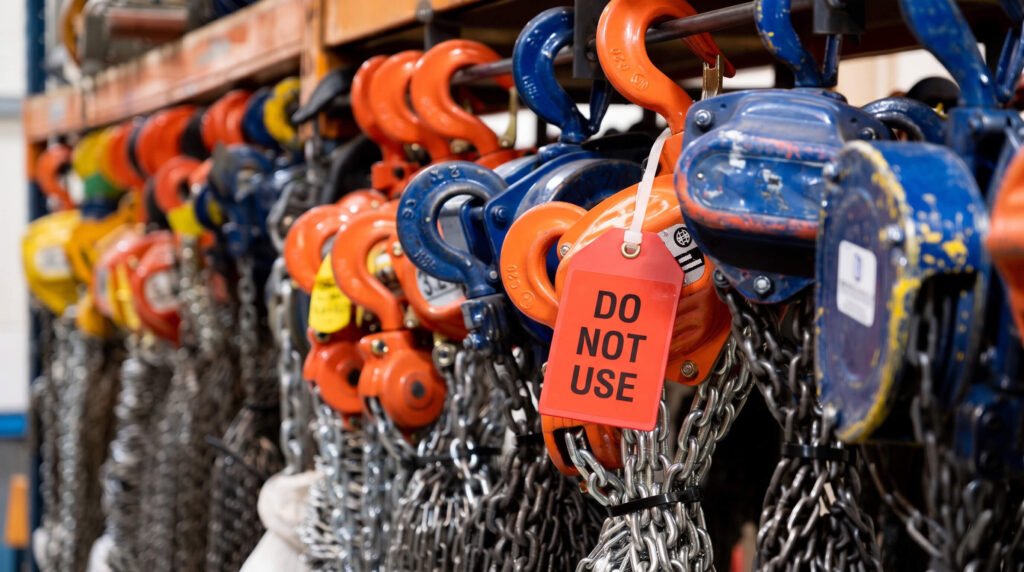
Tag the equipment clearly. Use a do-not-use or out-of-service tag, visible from any angle. The risk is someone walking past, not knowing it has failed, and picking it up for a quick job. A clear tag stops that.
Quarantine it physically. Move the failed kit away from the rest of the inventory if you can. A separate area, a locked store, or a marked bay all work. The aim is to make accidental reuse impossible, not just unlikely.
Get the written Report of Thorough Examination. The examiner will issue this after the inspection. Read it. It will name each defect, how serious it is, and what the timeframe for fixing it should be. Without the report you cannot make the right decision on what to do next.
Do not attempt repairs that fall outside your competence. Some defects can be fixed in-house. Others must go back to a manufacturer or a specialist. The report and the examiner will tell you which is which. A bodged repair is worse than no repair.
Tell anyone who needs to know. That includes the team using the kit, the project manager, and in some cases the duty holder responsible for the wider site. Compliance information is only useful if the right people have it.
These six steps protect the equipment, the people, and the duty holder. They also create the record that proves you acted properly, which matters if the failure is ever scrutinised.
Understanding the Report of Thorough Examination
The Report of Thorough Examination is the document that records what the examiner found. It is the most important piece of paperwork in the LOLER process, and it is the same document as your LOLER certificate.
Every report includes the same core information.
Identification of the equipment. The make, model, serial number and safe working load. This ties the report to a specific piece of kit so it cannot be confused with another item.
The date of the examination. Plus the date of the next one due, based on the equipment type and use.
Each defect found. With a description and an indication of how serious it is. This is the part that decides what happens next.
The timeframe for fixing each defect. Set by the examiner based on the risk. Some need to be fixed before the equipment can be used again. Others have a window.
The examiner’s details. Name, qualification and the body they are accredited by, usually LEEA. This is the proof that a competent person carried out the examination.
A clear statement on whether the equipment is safe to use. This is the bottom line of the report.
The duty holder must keep a copy of the report. Under LOLER, reports of thorough examination must be retained until the next report supersedes them, which for most equipment means at least two years. In practice, many duty holders keep them longer for audit and insurance purposes.
Insurance is the other reason the report matters. A current Report of Thorough Examination is often a condition of cover for sites using lifting equipment. If a failed report is missing or out of date, an insurer can decline a claim. The report is also the first thing an HSE inspector will ask to see.
For the most serious defects, the examiner has a legal duty to send a copy of the report to the relevant enforcing authority, usually the HSE. The duty holder does not need to do this themselves, but it is worth knowing the report is part of that chain.
If you want a fuller walkthrough of the inspection itself, our LOLER inspection guide covers the process and the frequency rules in detail.
Repair or Replace?
Once you have the Report of Thorough Examination in hand, the next decision is straightforward in principle. Repair, or replace? The answer depends on the equipment, the defect, and who is allowed to do the work.
When repair is the right answer
Some equipment can be repaired and brought back into service. The conditions are clear.
The work must be done by a competent person, ideally one who is qualified on that specific type of equipment. For most lifting kit, that means a manufacturer, an authorised service centre, or a specialist repair shop.
The repair must follow the manufacturer’s guidance. Improvised fixes, even by an experienced engineer, are not acceptable under LOLER. If the manufacturer has not approved the method, it is not a valid repair.
The equipment must be re-examined before it goes back into service. A new Report of Thorough Examination is required. The old report does not carry over.
A chain block with a damaged hand chain, an electric hoist with a worn brake, or a beam clamp with a faulty trigger can all usually be repaired and certified. For the wider context on chain block faults that can be caught early, see our chain block inspection guide.
When replacement is the only answer
Other equipment cannot be repaired. It must be replaced.
Lifting accessories are the clearest example. A worn or damaged sling, a stretched chain, a cracked shackle, a hook with an opened-up throat. Once these are found to be defective, they are scrap. There is no repair route. For more detail on the rules around accessories, see our LOLER inspection for lifting accessories guide.
The same applies to any item where the structural integrity of the load-bearing part has been compromised. A bent crane jib, a cracked lifting beam, a chain block with a damaged casing affecting the load path. These do not get welded or straightened back into service. They get replaced.
The honest test. If you find yourself wondering whether something can be repaired, the answer is usually that it cannot. Lifting equipment is unforgiving of compromise, and the cost of getting the call wrong is too high. If the manufacturer or a competent repair specialist will not put their name to a repair, replace it.
Getting the Job Back on Track
A failed LOLER inspection does not have to stop the work. The equipment is out of service, but the job can continue if you act fast.
Most duty holders take one of two routes. Repair and re-examine the original kit, or hire a certified replacement to keep the project running. The choice depends on the urgency, the cost, and how long the repair will take.
Repair is the better long-term answer if the kit is your own and the repair is straightforward. The downside is time. Even a quick fix needs a re-examination by a competent person before the equipment can go back into service. That can take days. On a live site, days of downtime is expensive.
Hire is the better short-term answer if the job cannot wait. A hired piece of equipment arrives with its own current Report of Thorough Examination. That means the compliance chain stays unbroken. You can keep working while the original kit is being repaired or replaced.
Two things matter when you bring in a replacement.
Check the certificate. The hired equipment must have a current Report of Thorough Examination, dated within the right interval for its type. Twelve months for most lifting equipment, six months for accessories. Without the report, the compliance chain is broken and you have just transferred the problem rather than solved it.
Keep the paperwork on site. Either a printed copy or a digital one on a phone or tablet. If an HSE inspector or a site auditor asks, you need to produce the certificate for the equipment that is currently in use, not the one in your store. The kit on the lift is the kit that needs to be compliant.
Many duty holders run a hybrid approach when something fails. The replacement equipment goes straight onto the job, with full certification. The original kit goes for repair without the pressure of stopping the work. Once the repair is finished, the original goes back into the fleet and the replacement can go back to the hire company. The cost of a few days of hire is almost always less than the cost of a stopped project.
If you need replacement lifting equipment on a tight deadline, our LOLER testing team can advise on options.
The Duty Holder’s Wider Responsibilities
A failed LOLER inspection is not just a problem to fix and forget. It is also a signal. Something has gone wrong in the maintenance, the inspection cycle, or the way the equipment was used. The duty holder needs to act on the wider picture, not just the failed item.
There are four things to look at after a failure.
Update the records. The inspection log needs the new information. The failed report, the action taken, the date the equipment came out of service, and the date it went back into service if it has. Records that do not match reality are worse than no records, because they look like a deliberate attempt to hide something.
Review the lift plan. If the failure was caused by an overload, a wrong choice of equipment, or a method that put the kit under more strain than it was rated for, the lift plan needs a fresh look. The failed equipment is the symptom. The plan that allowed it to happen is the cause.
Check the rest of the fleet. A single failed item is sometimes just bad luck. More often it is a sign that other items in the same batch, the same age, or the same use case are heading the same way. A quick review of similar kit can catch problems before the next examination does.
Notify insurance if there has been an incident. A failed inspection on its own is not usually a notifiable event. A failed inspection following a dropped load, a near miss, or any incident on site is a different matter. Most insurers require notification within a defined window, and a missed notification can void cover. If in doubt, tell them.
These four steps turn a failed inspection from a problem into useful information. They also create the audit trail that proves the duty holder responded properly, which matters if the failure is ever scrutinised by the HSE, an insurer, or a client.
LOLER Inspection Failure FAQ
Can a failed item be returned to service?
Yes, in many cases. Equipment with an immediate or serious defect must come out of service straight away. It can return only after the defect has been fixed by a competent person, following the manufacturer’s guidance, and a new Report of Thorough Examination has been issued.
Lifting accessories, such as worn slings or damaged shackles, usually cannot be repaired and must be replaced.
Who is responsible if hired equipment fails on site?
The hire company is responsible for supplying equipment in a safe and compliant condition, with a current Report of Thorough Examination. Once it is on your site, you are the duty holder for safe use, training and any examinations that fall due during the hire.
If hired equipment fails an inspection, contact the hire company immediately. They will usually replace it and handle the repair or disposal of the failed item.
How long should records be kept?
Reports of Thorough Examination must be kept until the next report supersedes them, which under LOLER is at least two years for most equipment.
Many duty holders keep them longer for audit, insurance and traceability. Keeping reports for the working life of the equipment is the safest practice.
What is the difference between an immediate and a serious defect?
An immediate defect means the equipment is dangerous and cannot be used at all. The kit comes out of service straight away. A serious defect means the equipment cannot be used until the fault is remedied, but there is no immediate risk of catastrophic failure.
Both are recorded on the Report of Thorough Examination, and both usually require the examiner to notify the relevant enforcing authority.
Does a failed inspection get reported to HSE?
Sometimes, yes. Under LOLER, the examiner has a legal duty to notify the relevant enforcing authority of any defect that is or could become a danger to people. The duty holder does not need to do this themselves.
In practice, this notification usually covers immediate defects and sometimes serious ones, depending on the examiner’s judgement. Lifting equipment is also subject to PUWER, the wider work equipment rules. Our LOLER and PUWER guide explains how the two work together.
Handle it Right and the Job Keeps Moving
A failed LOLER inspection is not a disaster. It is a problem that needs a fast, correct response.
Take the equipment out of service. Get the Report of Thorough Examination. Decide whether to repair or replace. Bring in certified replacement kit so the job keeps moving. Update the records, review the lift plan, check the rest of the fleet.
Done in that order, a failed inspection is a delay of hours or a day, not a stopped project. Skipped or done in the wrong order, it becomes a compliance problem, an insurance problem, and sometimes an HSE problem.
The duty holder’s response is what decides which one you get.
If you need a thorough examination, replacement equipment, or advice on what to do after a failed inspection, our LOLER testing team is here to help.